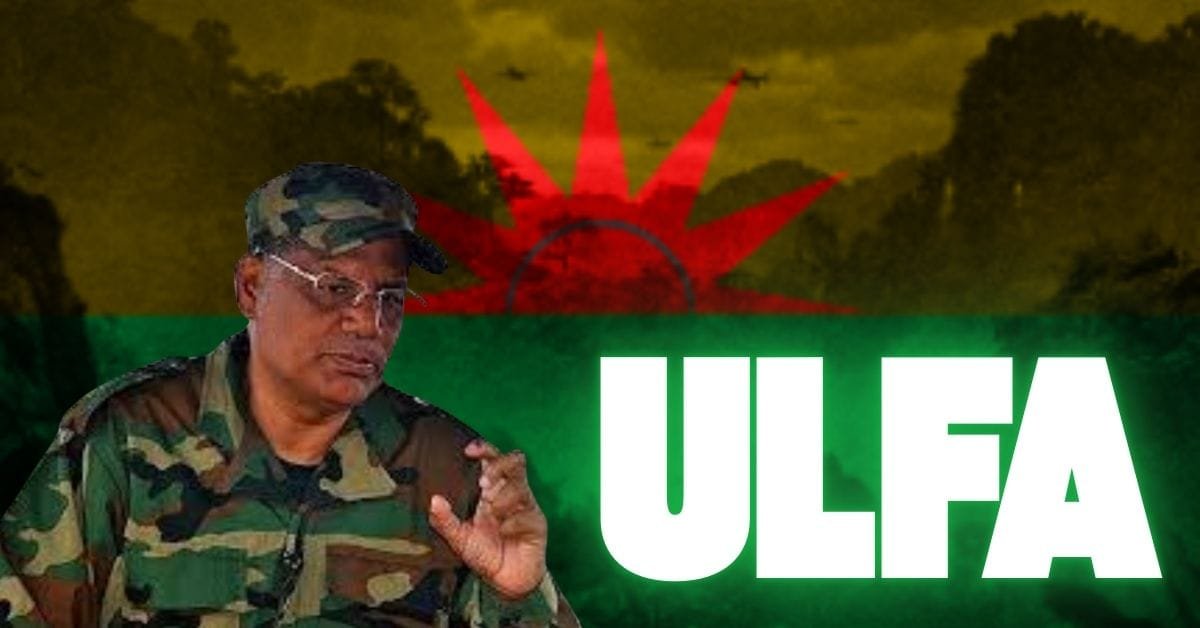
Despite a significant erosion in its operational strength over the years, the United Liberation Front of Asom (Independent), or ULFA(I), continues to maintain militant infrastructure beyond India’s borders. Recent arrests, intelligence disclosures, and reported aerial strikes have once again pushed the outfit into the spotlight, revealing a militant group grappling with dwindling resources, internal dissatisfaction, and sustained pressure from security forces.
Arrest of ULFA(I) ‘Operation Commander’ Reveals Ground Reality
The recent arrest of Rupam Asom, an “operation commander” of ULFA(I), from near the Assam–Arunachal Pradesh interstate border, has provided security agencies with crucial insights into the outfit’s current functioning.
During interrogation, Rupam reportedly admitted that ULFA(I)’s primary activity at present revolves around extortion, particularly in the border areas of Assam and Arunachal Pradesh. According to police sources, the outfit managed to collect nearly ₹6 crore in 2025 alone, with most of the funds coming from traders, contractors, and business units operating close to the border.
Cadres, however, are increasingly reluctant to venture deep into Assam, fearing detection and counter-insurgency operations. Interestingly, Rupam himself claimed that lower-level cadres have little to no knowledge about how this collected money is ultimately spent.
ULFA(I) Camps in Myanmar: Structure and Leadership
Although weakened, ULFA(I) is still operating three main camps inside Myanmar, taking advantage of the region’s instability and difficult terrain.
General Mobile Headquarters
The main camp of the outfit lies deep inside Myanmar and serves as the general mobile headquarters. This base is headed by senior leader Michael Deka Phukan and houses most of the remaining cadres. Limited training of new recruits still takes place here, although the scale has drastically reduced.
Eastern Camp
The second major base, known as the Eastern Camp, is reportedly headed by Nayan Asom. However, intelligence inputs suggest that this camp has remained largely inactive in recent times, reflecting operational stagnation within the outfit.
Arakan Camp (Camp 779)
The most active of all is the Arakan Camp, also referred to as Camp 779, under the command of Arunodoi Asom (now surrendered). This camp plays a key operational role, with its members frequently crossing into India to carry out extortion, abductions, and occasional violent acts. Rupam Asom was a member of this camp and was directly involved in such operations.
Shrinking Cadre Strength and Rising Discontent
Sources revealed that a 10-member ULFA(I) team led by Rupam crossed from Myanmar into India in February 2025 with the objective of raising funds and executing operations if possible. However, morale within the group was already low.
Three members surrendered at the first available opportunity, and Rupam’s subsequent arrest further weakened the team. Intelligence agencies believe the remaining members are currently hiding in Arunachal Pradesh.
Rupam reportedly disclosed widespread dissatisfaction among cadres, mainly due to the harsh living conditions in Myanmar-based camps. New recruits often join ULFA(I) with romanticised notions of armed struggle, only to confront the grim reality of jungle life—acute shortages of food, clothing, and basic medical care.
Internal factionalism has also become a serious issue, with intense competition among senior leaders to remain in the good books of ULFA(I) chief Paresh Baruah. Although Rupam was once considered close to Baruah due to his operational abilities, he had not met the leader for the past four to five years.
Security officials believe that if given safe surrender opportunities, a large number of cadres may choose to lay down arms.
Reported Drone Strikes on ULFA(I) Camps in Myanmar
In a major escalation, Indian security forces reportedly carried out aerial strikes using drones on ULFA(I) camps inside Myanmar during the early hours of a recent Sunday.
According to sources, over 100 drones targeted two major bases:
Diamond Camp near Hoyat village
The Central Mobile Headquarters in the Waktham area
The strikes reportedly killed at least three senior ULFA(I) leaders and injured several others, marking one of the most significant setbacks for the outfit since the Myanmar Army’s 2019 crackdown under Operation Sunrise.
ULFA(I), in emailed statements to the media, claimed that self-styled:
Lt Gen Nayan Asom
‘Brigadier’ Ganesh Asom
‘Colonel’ Pradip Asom
were killed, while at least 19 cadres were injured.
Official Silence and Strategic Speculation
While the Indian Army officially denied any such operation, defence sources indicated that the strikes were launched from forward areas under the Rangapahar-based 3 Corps. Reconnaissance and targeting reportedly took place over several days, with camps located around 10–15 km from the Indo-Myanmar border.
Sources described the action as “pre-emptive”, citing intelligence inputs that ULFA(I) cadres were recently sighted in Mon district and were actively planning attacks in Assam.
The outfit also alleged that drones of Israeli and French origin were used and claimed that camps belonging to other insurgent outfits, including PLA and NSCN factions, were also targeted—claims that remain unverified.
ULFA(I)’s Remaining Strength and Legacy
Despite consecutive setbacks, ULFA(I) is estimated to still have a cadre strength ranging between 250 and 400 members. Apart from the targeted camps, the group reportedly maintains:
A joint camp near Lahon in Nanyun township
Another base at Hakhi in the Pangsau area
The death of Nayan Asom, a native of Dumuria village in Assam’s Bajali district, also brought emotional reactions back home. A former meritorious student, he had left home in 1989 and remained estranged from his family for decades.
New Revelations After Arunodoi Asom’s Surrender
Fresh insights into ULFA(I)’s current state emerged following the surrender of top leader Arunodoi Dohotia (Arunodoi Asom). According to police sources, Dohotia disclosed that ULFA(I) chief Paresh Baruah has been living in China and has not visited the Myanmar-based camps for nearly a decade, distancing himself from cadres and senior leaders. This prolonged absence has deepened internal mistrust, particularly after the Kakopathar Army camp attack, which Baruah reportedly planned without consulting Dohotia.
Dohotia’s surrender was driven by multiple factors: declining morale after recent drone strikes on ULFA(I) camps, the realisation that the ongoing conflict had no future, and frustration over the deteriorating ideological foundation of the group. New recruits, he revealed, are poorly informed and lack political indoctrination, as no political classes have been conducted for years.
The strikes have also strained ULFA(I)’s alliances. Even Naga insurgent groups are now reluctant to shelter ULFA(I) cadres, fearing retaliation if linked to the outfit. Dohotia also said many ULFA(I) members now want to surrender but are unable to escape their Myanmar bases due to tightened surveillance and fear of attacks.
He could not bring his wife and two children while surrendering and managed to escape with only one bodyguard. Currently, the Myanmar camps are functioning under the leadership of Michael Deka Phukan, but overall morale remains critically low.
Conclusion: A Militant Outfit at Crossroads
The developments highlight a militant organisation struggling to survive amid shrinking manpower, worsening morale, and sustained security pressure. While ULFA(I) has vowed retaliation, the combination of arrests, surrenders, and targeted strikes suggests that the outfit is increasingly fighting for relevance rather than dominance.
For Assam and the Northeast, the focus now remains on ensuring border security, encouraging surrenders, and preventing exploitation of regional instability to revive armed insurgency.