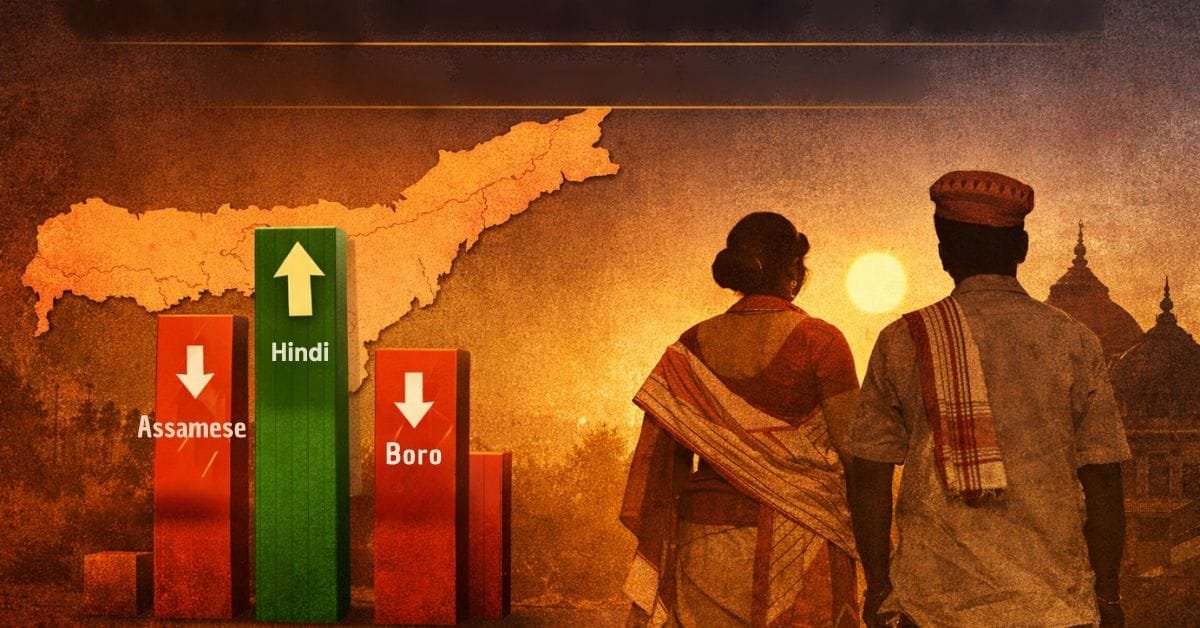
According to the 2018 Linguistic Census (released on the basis of the 2011 Census), Assam has witnessed significant changes in its linguistic composition over the last decade. One of the most striking trends is that the number of Assamese and Boro speakers has declined as a percentage of the total population, even as the state’s overall population has grown.
The total population of Assam, as per the 2011 Census, stands at 31,205,576. Of this, 2,101,435 people identified Hindi as their mother tongue, accounting for 6.73 per cent of the state’s population. In comparison, the 2001 Census recorded 513,773 Hindi speakers, which was 5.89 per cent of the population at that time. This indicates an increase of 1,587,662 Hindi speakers in just one decade.
If this growth trend continues at a similar rate, the number of Hindi speakers in Assam could cross four million in the coming decades. The impact of this shift is already visible in districts like West Karbi Anglong and Karbi Anglong, where the proportion of Hindi-speaking population has reportedly risen sharply, altering the district’s traditional linguistic balance.
Alongside Hindi, the number of Bengali speakers has also grown substantially. Their population increased from 7,343,338 (27.54%) in 2001 to 9,024,324 in 2011, according to the 2018 Linguistic Census. Together, Hindi and Bengali speakers now constitute a rapidly expanding segment of Assam’s population.
In 2001, Assam had 597 Hindi speakers per 10,000 people. Current estimates suggest this figure has increased significantly, reflecting the steady rise of Hindi as a major language in the state.
Indigenous Languages: Growth in Numbers, Decline in Share
The linguistic data released by the Union Home Ministry on June 28, 2018, also provides insights into indigenous language groups. Between 2001 and 2011:
Mishing speakers increased from 517,170 to 619,197
Karbi speakers rose from 406,160 to 511,732
Dimasa speakers grew from 108,133 to 131,474
Deuri speakers increased from 23,366 to 27,441
However, not all indigenous languages followed this trend. Rabha speakers declined from 130,875 in 2001 to 101,752 in 2011, raising concerns about language erosion.
The situation of the Boro language is particularly noteworthy. While the absolute number of Boro speakers increased from 1.316 million in 2001 to 1.416 million in 2011, their share of the total population fell from 4.86 per cent to 4.53 per cent. This indicates that the growth of the Boro-speaking population has not kept pace with the state’s overall demographic expansion.
A Growing Imbalance
Today, the number of Hindi speakers in Assam exceeds 2.1 million, while many indigenous communities—often referred to as the state’s Bhumiputras—remain numerically small and demographically vulnerable. Previous analyses suggest that Hindi speakers alone are increasing by around 1.5 million every decade, a trend that could have long-term cultural and political implications.
The census data clearly points to a gradual but persistent linguistic shift in Assam, raising critical questions about language preservation, cultural identity, and the future of indigenous communities in the state.